


Share
The Erin Meyer Culture Map Explained: 8 Scales Every Global Leader Needs
There is a moment that almost every leader working across cultures has experienced, even if they have never found the words for it. A meeting that felt efficient to one person felt rushed to another. Feedback that was meant kindly landed as a blow. Silence that signalled respect was read as disengagement. Nobody was wrong, exactly. But something was off, and nobody quite knew what to name it.
Erin Meyer's The Culture Map, published in 2014, gave that something a name. More precisely, it gave it eight names: eight scales along which cultures differ in their approaches to communication, leadership, decision-making, and trust. The framework has since become one of the most widely used tools in cross-cultural leadership development, and for good reason. It is precise without being rigid, research-grounded without being academic, and, crucially, it focuses on the workplace rather than on culture in the abstract.
But here is what often gets missed, both by people discovering the framework for the first time and by organisations that implement it too quickly: the eight scales are not a checklist. They are a web. You cannot understand what one scale is telling you without looking at how the others sit around it. That interdependence is not a complication of the model, it is the whole point.
What the Culture Map actually is
Erin Meyer is a professor at INSEAD business school and has spent decades researching how cultural values shape behaviour in professional settings. The Culture Map (PublicAffairs, 2014) emerged from that research and from thousands of hours of fieldwork with multinational leaders across every continent. The framework places cultures not individuals, on eight scales. Each scale represents a dimension of workplace behaviour where cultures cluster differently. The scales are:
-
Communicating — low-context to high-context
-
Evaluating — direct negative feedback to indirect negative feedback
-
Persuading — principles-first to applications-first
-
Leading — egalitarian to hierarchical
-
Deciding — consensual to top-down
-
Trusting — task-based to relationship-based
-
Disagreeing — confrontational to avoids confrontation
-
Scheduling — linear-time to flexible-time
The scales are relative, not absolute. Finland is not simply "low-context" but it sits further toward the low-context end than Brazil, but not as far as the United States in some contexts. What matters is always the gap between two cultures, not the absolute position of either one.

A quick tour of each scale
Communicating: what is said vs. what is meant
This scale, drawn originally from the anthropologist Edward T. Hall's distinction between low-context and high-context communication, asks how much of a message is made explicit versus how much is left for the listener to infer from context, tone, relationship, and situation. In low-context cultures like Finland, the Netherlands, or Germany, good communication is precise and literal. If something needs to be understood, it is said. Ambiguity is a failure of the speaker, not a test of the listener.
In high-context cultures like Japan, China, or Mexico, communication is layered. What is left unsaid is often as important as what is said. A silence, a hesitation, or an indirect phrase carries real information, if you know how to read it.
I see this play out concretely in my coaching work with leaders navigating the Finland–Mexico dynamic. A Finnish leader, trained to read communication at face value, will hear a Mexican colleague say "that could be interesting to explore" and register mild enthusiasm. What they may have missed is that, within the context of that relationship and that meeting, "that could be interesting to explore" was a polite no. The high-context speaker was not being evasive. They were being clear, in the language their culture trained them to use.
(For a deeper look at how communication style shapes feedback and trust between these two cultures, see this blog post about understading Mexican leadership style.)
Evaluating: how negative feedback is delivered.
This scale surprises people because it does not map neatly onto the Communicating scale. France, for example, is high-context in communication and yet French professional culture delivers negative feedback with notable directness, often in front of others. The Netherlands is low-context in communication but delivers criticism with a bluntness that can feel brutal to those not accustomed to it.
The distinction Meyer draws is between direct negative feedback and indirect negative feedback, specifically in professional evaluation contexts. In cultures that sit toward the direct end (Russia, the Netherlands, Israel, Germany), criticism is specific, frank, and considered a sign of respect. Softening it too much is seen as unclear or even condescending.
In cultures toward the indirect end (Japan, Thailand, Indonesia, Kenya), negative feedback is given privately, carefully, and often through implication. Public criticism is a significant breach of norms that can permanently damage a working relationship.
For leaders managing multicultural teams, this scale is one of the most practically urgent. A Brazilian manager giving feedback to a Japanese team member using the direct Brazilian norm may not realise they have created a rupture that will quietly undermine trust for months.
(More on how cultural difference drives global assignment failure: Cultural Intelligence ROI: Why Global Assignments Fail — And What to Do About It)

Persuading: where does the argument start?
Meyer draws here on a distinction between principles-first (deductive) and applications-first (inductive) reasoning. In principles-first cultures — France, Italy, Spain, Russia an argument is built from the theoretical foundation up. You establish the framework, the principles, the underlying logic. The conclusion follows naturally. Jumping to recommendations without laying the groundwork feels intellectually shallow.
In applications-first cultures, the United States, Canada, Australia, the argument begins with the recommendation or the bottom line, supported by examples and data. Getting to the point quickly is a mark of clarity and professionalism. A long theoretical preamble is seen as meandering.
This matters enormously in cross-cultural presentations and pitches. An American executive presenting to a French board and leading with "here is what I recommend and here is why it works" may find the room cooling before they finish the first slide. The French audience is not being difficult, they simply have not yet been given the intellectual framework they need to evaluate the recommendation. Trust the logic first; the conclusion can wait.
Leading: flat vs. hierarchical
This scale looks at how much distance is considered appropriate between a leader and their team, not just in terms of titles and formality, but in terms of who speaks, who decides, and what is permissible to say upward in the organisation.
Egalitarian cultures (Scandinavia, the Netherlands, Australia) expect leaders to be accessible, to consult widely, and to be challenged openly. A leader who does not invite pushback may be perceived as arrogant or insecure.
Hierarchical cultures (China, Japan, Mexico, Nigeria, Russia) expect the leader to be visibly in charge: to set direction clearly, to maintain some professional distance, and to make decisions that reflect their authority. A leader who appears too eager for consensus may be seen as weak or indecisive.
This is one of the scales I work with most directly in my coaching with leaders moving between professional environments. For example, Finnish leadership culture sits toward the egalitarian end, titles are used lightly, first names are universal, and the boss is expected to be one voice among many in a meeting. Mexican professional culture, by contrast, places significant importance on hierarchy, on the respect owed to the leader's position, and on the ritual that signals that respect.
A Finnish leader who walks into a Mexico City office and immediately drops the formality, invites everyone to use their first name, and asks the room to challenge their ideas openly may feel they are being warm and modern. Their Mexican colleagues may experience it as disorienting and quietly worry that something is wrong if the leader seems not to know their own authority. The Finnish leader may also drop the hierarchy and send emails to a person who is ranking higher than themselfves in the organizational chart. In Mexico, this would be a sign a disrespect.

Deciding: who makes the call, and when is it final?
This scale is subtler than it first appears, because it interacts in unexpected ways with the Leading scale. Meyer points out that the most hierarchical cultures are not always the most top-down in decision-making, and the most egalitarian cultures are not always the most consensual.
Japan sits toward the egalitarian end on Leading, bosses are not distant authority figures, and yet Japanese organisations make decisions through an extremely consensual process called nemawashi, building alignment at every level before anything is formally decided. Sweden, also egalitarian, runs on a similarly consensus-heavy process.
The United States, by contrast, is relatively egalitarian in leadership style but distinctly top-down in decision-making: the leader consults, then decides, and the decision is generally considered final until circumstances change it.
Germany sits in a fascinating position: the decision-making process is long and methodical, because Germans want to be certain before committing but once a decision is made, it is very difficult to revisit. In the US, decisions are made quickly and revised often. These two approaches, in the same project, create friction that neither side initially understands.
Trusting: does trust come from work or from relationship?
This is one of the most consequential scales for international business, and one of the least discussed. Meyer distinguishes between cognitive trust — trust built through professional reliability, track record, and demonstrated competence — and affective trust, which is built through personal relationship, shared meals, time spent together outside of work, and a genuine human connection. You can think of them of trusting with your head and trusting with your heart.
Task-based trust cultures (the United States, Germany, Denmark, Australia) operate primarily on cognitive trust. You are trusted because you deliver. The personal relationship is pleasant but not structurally necessary. You can have a highly functional, even warm professional relationship with someone you have never had dinner with.
Relationship-based trust cultures (China, Brazil, Saudi Arabia, Nigeria, India) require affective trust before the real work can begin. This does not mean they are inefficient, it means they have a different definition of efficiency. The hours spent building a personal connection are not a delay before the deal; they are part of the deal. Skipping them produces fragile agreements that collapse under the first pressure.
In my work with leaders preparing for global assignments, this scale often reveals the most costly misunderstandings. A leader from Germany or Finland arrives in Brazil, conducts a perfectly professional series of meetings, concludes the agreements seem solid, returns home, and then watches the relationship slowly deteriorate without ever understanding why. The Brazilian counterpart, still waiting for the personal investment that signals genuine partnership, has quietly concluded that this relationship is not worth their full commitment.
(For more on how this plays out in relocation and global assignments, see: How Positive Psychology Can Support Expats During Relocation)
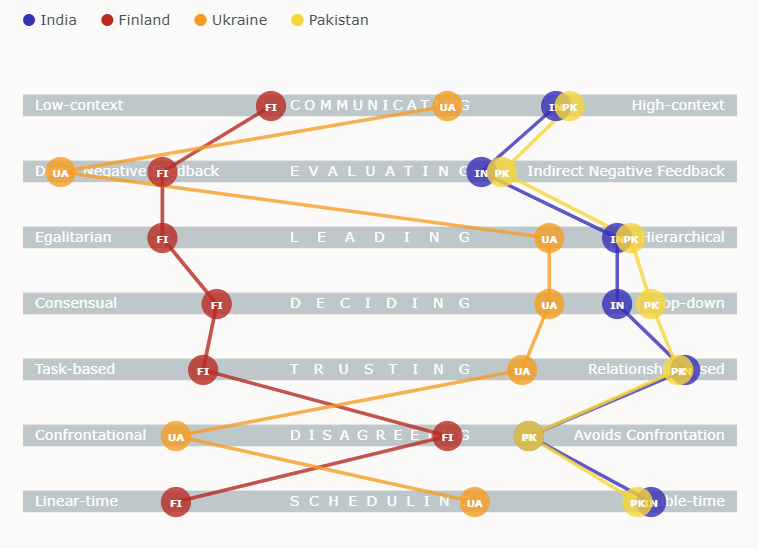
Erin Meyr's Culture Map
Disagreeing: is open debate a sign of health or aggression?
Cultures vary significantly in how comfortable they are with open, direct confrontation of ideas in a group setting. In confrontational cultures (France, Israel, the Netherlands, Russia), arguing passionately about ideas is a form of intellectual engagement. It does not damage the relationship, if anything, it builds respect. Walking away from a heated debate still friends is normal, even expected.
In cultures that avoid confrontation in group settings (Japan, Indonesia, Thailand, Ghana), open disagreement, especially with a senior figure, is a serious breach of group harmony. Disagreement happens, but through private channels, indirect language, or after the meeting rather than during it.
This scale creates specific friction in multinational team meetings. A French team member who challenges a proposal forcefully in front of the group may feel they are doing their job well, holding the team to intellectual rigour. An Indonesian colleague in the same room may experience this as aggressive, damaging, and completely unnecessary. Neither interpretation is wrong. They are simply calibrated to different norms.
Scheduling: is time a line or a circle?
The final scale asks how cultures relate to time, plans, and the structure of a working day. In linear-time cultures (Germany, Switzerland, Sweden, the United States), time is a scarce, finite resource that is planned in advance and protected. Punctuality is a form of respect. Agendas are followed. Deadlines are real.
In flexible-time cultures (India, Saudi Arabia, Nigeria, Brazil), time is more elastic. Plans are approximate starting points that adapt to human realities. What is happening now takes precedence over what was scheduled to happen. This is not disorganisation, it is a different philosophy about what constitutes a good use of time. A person who drops everything when a colleague arrives unannounced is prioritising the relationship over the plan. From their frame, this is the correct choice.

Why you cannot read the scales in isolation
Now for the part that most summaries of the Culture Map leave out. And the part that, in my experience, makes the biggest difference between surface-level and genuinely applied cultural intelligence. The scales interact. They do not simply add up. Understanding a culture's position on the Leading scale without knowing where it sits on Deciding, Trusting, and Evaluating will lead you to wrong conclusions roughly half the time.
Take the Japan example again. On Leading, Japan sits toward the egalitarian end, the boss is not a distant authority figure in the way that a Nigerian or Mexican boss might be. A reader skimming the framework might conclude: Japan is a flat culture, challenge is welcome, consensus is important. So far, so reasonable.
But now add the Communicating scale: Japan is among the most high-context cultures in the world. Disagreement, challenge, and even simple requests are delivered indirectly. Add Evaluating: negative feedback is intensely indirect, private, and given through carefully coded signals rather than explicit statements. Add Disagreeing: open confrontation in a group is to be avoided at almost any cost. Now add Trusting: relationship-based, requiring sustained personal investment before professional commitment is real.
What you now have is a picture that is far more nuanced and far more actionable. Japan is not a flat culture in the way Finland is flat. The egalitarianism expresses itself differently, filtered through communication norms that prioritise harmony and indirect signalling. A leader expecting Finland-style directness and openness to challenge because the Leading scale suggested egalitarianism, will misread almost every meeting they sit in.
Or consider the US–France comparison. Both are relatively confrontational on Disagreeing. Both tend toward the direct end on Evaluating. A European leader might conclude: the French and Americans are similar on conflict. But on Persuading, they are almost opposites. The French need theory first; Americans want the bottom line. On Deciding, the French are more methodical and less likely to reverse a decision; Americans decide fast and iterate. The result is that two apparently similar cultures on some scales produce completely different experiences in a boardroom negotiation.
This is what makes the Culture Map genuinely powerful as a coaching tool, rather than a party trick or a cultural trivia exercise. Used well, it invites leaders to map not just where cultures sit on individual scales, but how those positions combine to produce the specific friction or the specific synergy, they are experiencing in a real room, with real colleagues.
In my coaching sessions, I use participants' own Culture Map profiles alongside the profiles of the cultures they work with, and we explore these intersections explicitly. Where are the natural alignments? Where are the gaps most likely to be misread as personality problems rather than cultural differences? And, this is the critical question, where does the gap on one scale amplify the gap on another? All of them are manageable — once they are visible. The leader who can see the whole map, not just one scale at a time, is the one who can start adapting.
What the Culture Map is not
A few important caveats that Meyer herself emphasises in The Culture Map. The scales describe cultures, not individuals. Every culture contains enormous individual variation. A Mexican leader who grew up partly in the United States, studied in Germany, and has led international teams for twenty years will not sit in the same position as the Mexican national average. The map is a starting point for observation, not a verdict on any person.
The scales are relative, not absolute. Finland looks very direct when a Finnish leader is working with a Japanese colleague. The same Finnish leader looks indirect when working with a Dutch colleague. Your own cultural position only becomes visible in contrast with another.
And the scales can be learned. This is the hopeful core of everything Meyer's work points toward. Cultural difference is not a fixed incompatibility. It is a set of patterns that can be understood, navigated, and over time genuinely bridged. That is what cultural intelligence development is for.
Tanja Saarinen Chávez is an intercultural communication coach and cultural intelligence trainer based in Helsinki. She works with leaders and organisations navigating cross-cultural complexity in Europe, Latin America, and beyond. If you would like to explore how the Culture Map applies to your team or leadership context, get in touch.
Reference: Meyer, E. (2014). The Culture Map: Breaking Through the Invisible Boundaries of Global Business. PublicAffairs.
Tanja is a Certified Intercultural Communication Coach and Positive Psychology Practitioner. With a Master's Degree in Business Administration, specializing in Leadership and People Management, she helps companies and supports expats and multicultura team leaders in comprehending cultural dimensions and leveraging existing cultural differences to create powerful organizational strengths.
About the Author
Related Articles


Company
Good to know
Stay up to date on the latest news and expand your horizons!
©2024 Numinos Ltd | Intercultural Communication Training | Finland & Mexico