


Share
What Causes Friction in Multicultural Teams in Finland?
Multicultural teams are now a normal part of working life in Finland. Yet many international professionals and leaders are surprised by how often small misunderstandings slow collaboration even when everyone is competent, motivated, and well‑intentioned.
If you haven’t yet read our broader overview of leadership and communication in Finnish workplaces, start with Leading Multicultural Teams in Finland, where we explore how Finnish work culture shapes everyday collaboration in international teams.
Friction in multicultural teams in Finland rarely comes from open conflict. Instead, it grows quietly from different expectations about communication, decision-making, and responsibility. Expectations that are often left unspoken.
When Nothing Is Wrong — But Something Still Feels Off
Imagine this situation: a German project manager presents a clear, structured plan in a meeting. Finnish colleagues listen attentively, nod, and the meeting ends on time. No objections are raised. Later, the project manager feels uncertain. Was the plan approved or merely acknowledged?
For the Finnish team members, the situation feels straightforward: the plan was acceptable, and there was no need for further discussion. No one did anything wrong, yet uncertainty and tension still emerge. This is a classic example of cross-cultural communication friction in Finnish workplaces. The issue is not competence or attitude, it is interpretation.
Small Differences in Communication Create Big Misunderstandings
In Finnish work culture, communication tends to be concise, task-focused, and low on verbal reinforcement. Silence often signals concentration, respect, or agreement. In many other cultures, however, silence may suggest hesitation, disengagement, or lack of commitment.
In multicultural teams, these different interpretations easily collide:
-
International professionals may expect verbal confirmation and discussion
-
Finnish colleagues may expect understanding without extensive verbal exchange
Without explicit discussion of these styles, frustration builds quietly and teams begin to misread each other.
Silence in Finnish Meetings: Strength or Source of Tension?
Silence plays a unique role in Finnish work culture. It allows space for thinking and signals trust in others’ competence. But in multicultural teams, silence can easily be misunderstood. A leader who understands cross-cultural leadership in Finland helps the team by explaining how silence functions and by encouraging small verbal signals that create shared understanding without forcing anyone to change their natural style.
Making these norms visible is often enough to reduce unnecessary tension.

Self-Direction: Freedom That Needs Clarity
Finnish workplaces are known for low hierarchy and strong trust in employees’ independence. Phrases like “do what you think is best” are meant to empower and signal confidence in professional competence. In Finnish work culture, autonomy is often seen as a sign of respect and equality.
Yet for many international professionals, this approach can feel unclear rather than freeing especially in a new cultural and organizational context. To get a better insights into hierarchy and authority, I recommend reading my post about power distance.
When expectations are not explicitly discussed, self-direction may turn into uncertainty rather than motivation. Without clearly defined goals, priorities, and boundaries, international team members may hesitate, unsure whether they are acting proactively or overstepping invisible limits.
This uncertainty often shows up in questions like:
-
Am I focusing on the right things?
-
How much initiative is expected from me in this role?
-
When should I ask for guidance, and when am I expected to decide independently?
In multicultural teams, these questions are rarely voiced openly, even though they are shared by many.
Strong leadership in multicultural teams does not remove autonomy, it anchors autonomy with clarity. By explaining expectations, decision-making boundaries, and success criteria, leaders in Finnish workplaces can preserve independence while reducing unnecessary uncertainty and mental load.
Feedback Culture and Cultural Misinterpretations
Finnish feedback is typically direct, factual, and restrained. Positive feedback may be brief or implied, while corrective feedback focuses on the task rather than emotions or personal validation. In Finnish work culture, this approach is often seen as efficient, respectful, and fair. There is no need to “dress up” feedback if the message is clear.
In multicultural teams, however, this style can easily be misinterpreted as coldness, lack of appreciation, or emotional distance. International professionals coming from more expressive feedback cultures may expect regular verbal encouragement or relationship-oriented framing, and its absence can feel discouraging rather than neutral. This is especially risky among some Finnish leaders who may still believe that feedback should be only given when it is constructive, silence is a sign that everything is going well.
This difference is well illustrated in Erin Meyer’s cultural dimension of feedback, where cultures vary in how directly negative feedback is given and how much positive reinforcement is expected alongside it. Finland tends to fall on the more direct end of the feedback scale, while many other cultures rely on more indirect language and stronger positive framing before addressing issues.
Explaining Finnish feedback norms helps international team members understand that directness often signals trust, professionalism, and equality, not criticism or dissatisfaction. At the same time, leaders working in multicultural teams benefit from adding intentional positive reinforcement, making appreciation more visible without abandoning clarity.
When feedback styles are discussed openly, teams can avoid unnecessary emotional interpretation and instead focus on learning, performance, and mutual respect across cultures.
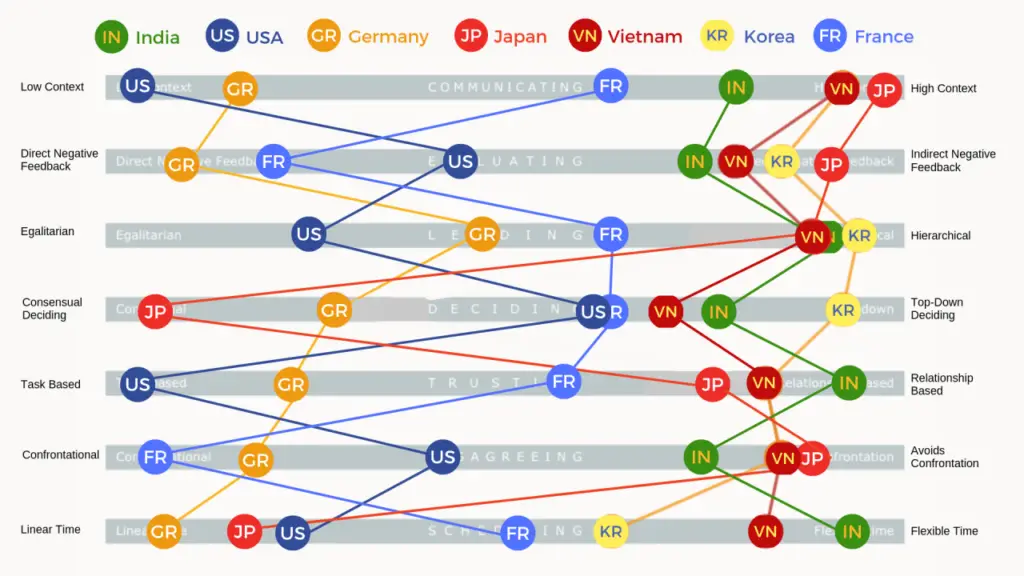
Erin Meyer's culture map
Unspoken Rules Create Invisible Friction
Every workplace has unwritten rules — about meetings, decision-making, responsibility, and communication. In homogeneous teams, these rules are learned informally. In multicultural teams in Finland, they often remain invisible.
This invisible knowledge gap is one of the biggest sources of friction in multicultural workplaces. People spend energy guessing instead of focusing on meaningful work. Cross-cultural training helps teams identify these unspoken rules, agree on shared norms, and create communication practices that work for everyone.
From Friction to Flow in Multicultural Teams
Friction in multicultural teams in Finland is rarely about disagreement. It is about unclear expectations and unspoken assumptions.
By making communication norms visible, clarifying decision-making processes, and openly discussing different working styles, teams can move from silent frustration to smoother collaboration.
At Numinos Coaching, we support organizations and international professionals with cross-cultural training in Finland, focusing on practical communication skills, leadership clarity, and sustainable collaboration in multicultural teams.
Tanja is a Certified Intercultural Communication Coach and Positive Psychology Practitioner. With a Master's Degree in Business Administration, specializing in Leadership and People Management, she helps companies and supports expats and multicultura team leaders in comprehending cultural dimensions and leveraging existing cultural differences to create powerful organizational strengths.
About the Author
Related Articles


Company
Good to know
Stay up to date on the latest news and expand your horizons!
©2024 Numinos Ltd | Intercultural Communication Training | Finland & Mexico